Guide
Naksha Se Pehle Plot Ki Jaanch: Kaagaz, Naap, Sadak, Setback, Mitti
Before a house plan is drawn, check the plot: land papers, all four sides and diagonals, road side and width, setbacks, approval route, seismic zone and soil.
By the Design SQR team · 27 Oct 2026 · 6 min read
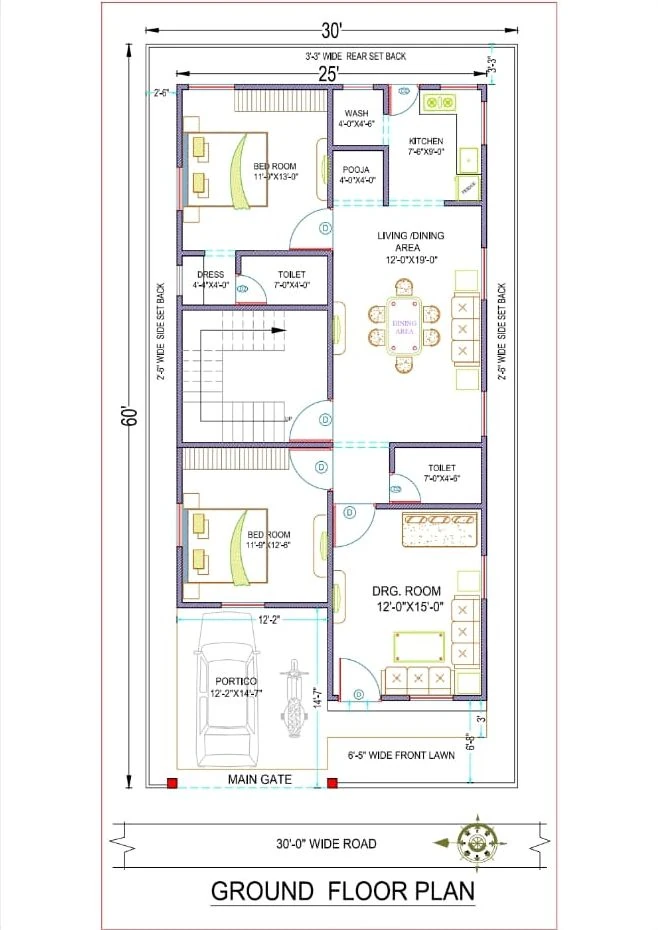
Before you get a naksha drawn, check the plot itself on seven points: the land papers, its real measurements, the road side and road width, the setbacks your town requires, the approval route, the earthquake zone and the soil. A plan drawn on wrong measurements or for a plot with a title problem is money wasted. For what to decide about the house itself (rooms, light, stairs and services), read our 15 things to consider before making a house floor plan.
Seedhi baat: architect ko naksha ke liye sirf plot ka size kaafi nahi hai. Kaagaz, naap, sadak ki disha aur mitti ki jaankari pehle taiyaar rakhiye.
1. Plot ke kaagaz: khasra, khatauni, registry
Check that the seller's name in the khatauni (jamabandi or B-1 in some states) is the same as on the sale deed, and that the khasra number matches. The khasra number identifies the piece of land, the khatauni says who owns it and how much, and the bhu-naksha is the village map showing its shape next to its neighbours. Most states let you view these free on an official website. After you buy, apply for mutation (dakhil-kharij) so the record shows your name. Our land records guide lists the official sites state by state, and the same is in Hindi at bhulekh khasra khatauni kaise dekhe.
The bhu-naksha is a village-scale map, not exact enough for a house plan. The house plan is drawn from the plot's measured sides.
2. Plot ka naap: all four sides and both diagonals
Measure all four sides on site, not only the two in the sale deed. Then measure both diagonals: if they are not equal, the plot is not a true rectangle, and the plan must follow the real shape. A plot of "30x60" that is 29 ft at the back changes the rooms at the back. Our step-by-step guide to measuring a plot shows how.
If your papers give the area in gaj, marla, bigha or katha, convert it carefully: 1 gaj is 9 sq ft, so 100 gaj is 900 sq ft. A bigha changes from state to state. Our plot units guide has the conversions.
3. Sadak kis taraf hai, aur kitni chaudi hai?
The road side is the plot's "facing": a plot with the road on its east side is east facing. It decides where the gate, parking and main door can go. Note:
- which side the road is on, and whether there is a road on a second side (a corner plot);
- the road's width, which in some states decides how many floors you may build;
- the level of the road against your plot, so the plinth can be set above it.
Read east, north, west or south facing for how facing changes sun, heat and layout.
4. Setback: kitni jagah chhodni hai
Setbacks are the open space the bye-laws make you leave inside the plot. In Uttar Pradesh's 2025 bye-laws, for example, plots under 150 sq m need 1 m at the front and none at the back or sides; plots of 150 to under 300 sq m need 3 m at the front and 1.5 m at the back. Other states differ, so check your state's rules before the rooms are drawn: Uttar Pradesh, Bihar, Delhi, Haryana, Madhya Pradesh and Rajasthan.
5. Naksha pass ka rasta
Find out who approves maps where your plot is: a development authority, a regulated-area office or a municipality. In UP development authority areas, residential plots up to 100 sq m need no permission, only online registration; bigger plots in those areas go through FASTPAS at map.up.gov.in. The details are in naksha pass kaise karaye. Map approval is not the same as a land record: the bhulekh shows ownership, the approved map shows what you may build.
6. Earthquake zone
India's seismic code, IS 1893 (Part 1):2016, puts every place in a zone from II to V. The zone changes the steel and detailing in your columns and beams, so your engineer needs it before the structural drawings. Our city pages give the zone for each city we have a guide for.
7. Mitti (soil)
Tell us if the plot is filled land, near a pond or an old drain, or if water stands on it in the monsoon. In such cases, or for a house of three floors or more, a soil test before the foundation design is money well spent. The Bureau of Indian Standards code for this work is IS 1892:2021, subsurface investigation for foundations.
Phir ghar ki baat: budget aur parivaar
Once the plot is clear, fix a rough budget and a room list. The plan decides the built-up area and the built-up area decides most of the cost. Use the cost calculator or read ghar banane ka kharcha. The naksha fee itself is on our rate card: see ghar ka naksha kitne ka banta hai.
If you will add a floor later, say so now: columns and footings must be designed for the floors you will add, not only the ones you build first.
What to send us
The plot's four sides (and diagonals if you have them), the road side and road width, the city, your room list and a few photos of the plot. A 2D plan is ready in 2–3 days, and you get two rounds of changes after the first draft. Browse real house plans to see how others used similar plots.
Common questions
Naksha banwane ke liye kaun se kaagaz chahiye?
To draw the plan, only the measurements and road side. To get the map passed, proof of ownership: in Uttar Pradesh the sale or lease deed or the authority's possession letter; other states ask for their own set.
Kya bhu-naksha se ghar ka naksha ban sakta hai?
Not on its own. The bhu-naksha is a village-scale map. The house plan is drawn from the plot's measured sides; the bhu-naksha helps you check the plot's shape and its neighbours.
Do I need a soil test for a small house?
Not always. Ask for one on filled or low-lying land, near water, or for three floors and more.
Sources
- Uttar Pradesh Model Building Construction and Development Byelaws 2025, §2.1.2 and §3.2.4.1 — http://gdaghaziabad.in/wp-content/uploads/2026/02/UP-Model-Building-Bylaws-2025_3July_250704_125142-1.pdf
- BIS, IS 1893 (Part 1):2016, criteria for earthquake resistant design of structures.
- BIS, IS 1892:2021, code of practice for subsurface investigation for foundations — https://shop.standards.ie/en-ie/standards/is-1892-2021-191428_saig_bis_bis_3095621
- State land-record websites, as listed on our land records guide (opened 27 October 2026).
Send your plot size, road side and room list on WhatsApp, or use the quote form, and we will start the plan from there.
Planning a home on your own plot?
Share your plot size, facing and city. A designer will call you back within one working day with layout options and an honest cost range.