Guide
Measurement of Open Land (Length & Width of the Plot)
Accurate measurement ensures correct area , better planning and a smooth construction process.
By the Design SQR team · 24 Oct 2026 · 7 min read
How to Measure the Length and Width of an Open Plot of Land: A Practical Guide By Design Sqr | Civil Engineering & Land Measurement Introduction Measuring an open plot of land is one of the most important steps before starting any construction project. Accurate land measurement helps determine the plot's dimensions, calculate its total area, prepare a building plan, estimate construction costs, and establish the correct plot boundaries. Whether you are planning to construct a residential house, a commercial building, or a boundary wall, understanding how to measure the length and width of your plot is essential. In this blog, we will explain the practical method of measuring an open plot using simple tools and professional surveying techniques.
- Tools Required for Plot Measurement
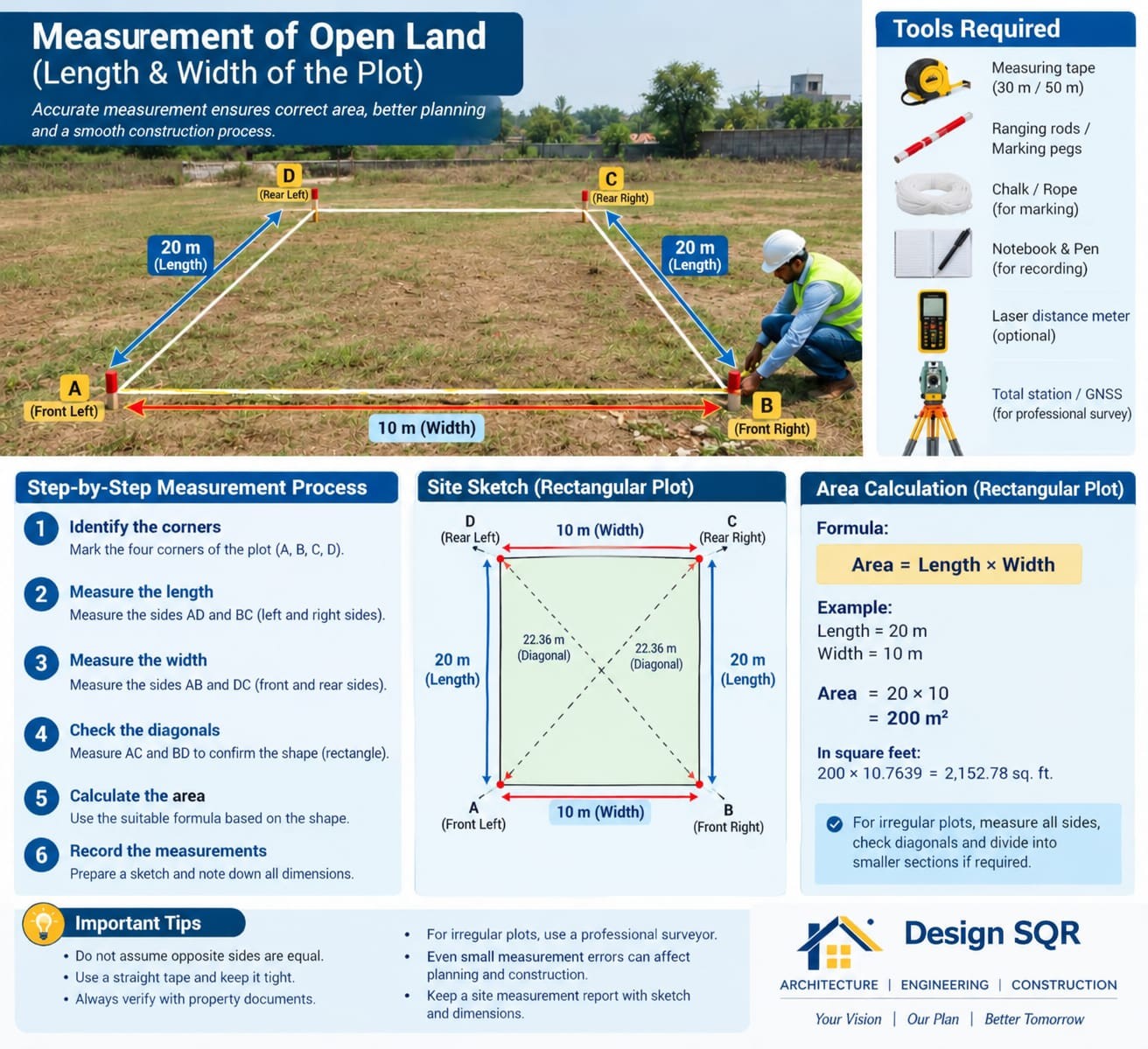
Before visiting the site, arrange the following tools: Measuring tape (30 m or 50 m) Steel tape for shorter measurements Measuring wheel, where suitable Ranging rods or marking pegs Chalk, rope, or marking paint Notebook and pen Calculator Laser distance meter, if available Total station or GNSS surveying equipment for professional surveys, where required Professional tip: For construction planning, use reliable measuring equipment and verify the plot's boundary points before recording the dimensions.
- Identify the Four Corners of the Plot
First, identify the four boundary corners of the plot. For a rectangular plot, label the corners as follows: Point A: Front-left corner Point B: Front-right corner Point C: Rear-right corner Point D: Rear-left corner These four points help establish the plot's shape and make it easier to record the measurements. Ensure that the identified corners correspond to the actual legal boundaries of the property.
- How to Measure the Length of the Plot
Follow these steps to measure the length: Place the starting end of the measuring tape at Point A. Extend the tape along the plot's side boundary toward Point D. Keep the tape straight and properly aligned with the boundary. Record the measurement in metres or feet. Repeat the measurement along the opposite side, from Point B to Point C. For example: Left-side length (AD) = 20 metres Right-side length (BC) = 20 metres If both measurements are equal, the plot may have a uniform length, but the other dimensions and diagonals should also be checked. Important: Do not assume both sides are equal. Measure each side separately.
- How to Measure the Width of the Plot
To measure the width: Place the measuring tape at Point A. Extend it along the front boundary to Point B. Record the front width. Repeat the process along the rear boundary, from Point D to Point C. For example: Front width (AB) = 10 metres Rear width (DC) = 10 metres If both measurements are equal, the plot has the same front and rear widths. If the measurements differ, the plot may be tapered or irregular, and its area should be calculated using an appropriate surveying method.
- Calculate the Total Plot Area
For a rectangular plot, use the following formula: Plot Area = Length × Width Practical Example Suppose the measured dimensions are: Length = 20 metres Width = 10 metres Calculation: Area = 20 × 10 Total Plot Area = 200 square metres To convert the area into square feet: 200 × 10.7639 = approximately 2,152.78 square feet. Therefore, a rectangular plot measuring 20 m × 10 m has an area of approximately 2,153 square feet. Remember that this formula applies directly to a rectangular plot with perpendicular sides.
- How to Check Whether the Plot Is Square or Rectangular
Measuring only the length and width may not be enough to confirm that a plot is rectangular. A useful method is to measure both diagonals: Diagonal AC Diagonal BD For a true rectangle, the two diagonals should be equal, subject to measurement accuracy. For a plot measuring 20 m × 10 m, the expected diagonal is: Diagonal = √(20² + 10²) Diagonal = √500 Diagonal ≈ 22.36 metres If the diagonals differ significantly, recheck the measurements and corner positions. However, equal diagonals alone do not establish legal boundaries or prove that the land is a rectangle.
- What If the Plot Is Not Rectangular?
Many open plots are irregular, trapezoidal, or have unequal side lengths. In these cases, do not simply multiply the longest side by the widest side. Instead: Measure all boundary sides. Record the front and rear widths. Measure suitable diagonals or establish survey points. Divide the plot into triangles or other measurable sections. Calculate the area of each section. Add the individual areas to determine the total. For complicated plots, sloping ground, disputed boundaries, or land registration work, consult a qualified land surveyor.
- Practical Site Measurement Workflow
For accurate measurements on a construction site, follow this workflow: Step 1: Review the documents Check the available sale deed, approved layout, site plan, or survey records. Step 2: Inspect the site Identify visible boundary markers, existing structures, roads, drains, and neighbouring plots. Step 3: Establish the boundary points Confirm the corners using reliable survey information. Do not rely solely on fences or walls, as they may not coincide with the legal boundaries. Step 4: Measure all four sides Record the front, rear, left, and right dimensions separately. Step 5: Check the diagonals Use diagonal measurements to help verify the geometry of the plot. Step 6: Record the measurements Prepare a simple sketch and write each measurement beside the corresponding boundary. Step 7: Calculate the area Use the appropriate formula for the plot's actual shape. Step 8: Verify the results Repeat critical measurements and compare the calculated dimensions with the available property documents. Step 9: Prepare the site measurement report Include the plot sketch, dimensions, calculated area, measurement units, date, and any limitations or discrepancies found.
- Common Mistakes to Avoid
Avoid these common errors when measuring open land: Measuring only the front and one side. Assuming that opposite sides have equal lengths. Allowing the tape to sag or deviate from the intended measurement line. Confusing metres with feet. Ignoring irregular corners or angled boundaries. Calculating an irregular plot's area using the rectangular formula. Assuming a boundary wall always represents the legal property line. Failing to compare site measurements with property documents. Even a small measurement error can affect building setbacks, layout planning, and construction quantities.
- Why Accurate Plot Measurement Matters in Civil Engineering
Accurate plot measurement provides the foundation for several construction activities, including: Architectural planning and building layout. Setback and open-space planning. Boundary wall construction. Estimation of construction quantities. Site levelling and grading. Drainage and access planning. Verification of plot dimensions against property records. Before construction begins, the dimensions and boundaries should be verified to reduce the risk of planning errors and disputes. Conclusion Measuring the length and width of an open plot is a basic but essential civil engineering task. By identifying the correct boundary points, measuring all four sides, checking the diagonals, and applying the correct area formula, you can obtain a reliable understanding of the plot's dimensions. For simple rectangular plots, the length × width formula is sufficient. Irregular plots require more detailed calculations or a professional land survey. At Design Sqr, accurate site measurements are an important first step toward reliable architectural planning and successful construction. Disclaimer: This article provides general guidance for preliminary site measurement. Legal boundary determination, cadastral surveys, and official land-area certification should be handled by appropriately qualified professionals in accordance with applicable local requirements.
Planning a home on your own plot?
Share your plot size, facing and city. A designer will call you back within one working day with layout options and an honest cost range.