Guide
PM Surya Ghar Rooftop Solar for a New House: Subsidy and Roof Plan
PM Surya Ghar pays ₹30,000 per kW for the first 2 kW and ₹18,000 for the third, up to ₹78,000. Plan a new roof for it: shade-free area, mumty, tank, conduit.
By the Design SQR team · 27 Oct 2026 · 7 min read
Under PM Surya Ghar: Muft Bijli Yojana, a household with a residential electricity connection can get central financial assistance (CFA) of ₹30,000 per kW for the first 2 kW and ₹18,000 for the third kW of a grid-connected rooftop solar system: ₹78,000 at most, because nothing more is paid beyond 3 kW. In the special-category states and UTs the rates are ₹33,000 and ₹19,800. For a new house, the roof decides what you can fit, so plan a shade-free area, the mumty, the water tank and a cable route from the roof to the meter before the top slab is cast.
These are the figures in MNRE's operational guidelines for the scheme, which we read on 27 October 2026. The guidelines allow the benchmark cost behind them to be revised, so confirm on the national portal, pmsuryaghar.gov.in, before you apply.
Seedhi baat: subsidy 3 kW tak hi milti hai, aur panel ki jagah chhat par naksha banate waqt hi chhodni padti hai.
The subsidy, worked out
The guidelines give these examples:
- a 1.5 kW system: ₹30,000 × 1.5 = ₹45,000
- a 2.5 kW system: ₹30,000 × 2 + ₹18,000 × 0.5 = ₹69,000
- a 6 kW system: ₹30,000 × 2 + ₹18,000 × 1 = ₹78,000, the same as for 3 kW
The special-category states and UTs named in the guidelines are Uttarakhand, Himachal Pradesh, Jammu and Kashmir, Ladakh, the North-Eastern states including Sikkim, Andaman and Nicobar, and Lakshadweep; by the same arithmetic their ceiling is ₹85,800. A state may add its own subsidy on top, paid through the same portal.
Who is eligible
The main conditions in the guidelines, in plain words:
- A residential connection. You apply with a valid consumer account number from your electricity distribution company (DISCOM), and the system is tagged to that residential connection. No CFA goes to commercial or government connections.
- On the building. Panels go on a roof, terrace or balcony, or on an elevated structure. A system on an elevated structure qualifies only if the structure has a minimum ground clearance of 8 ft at its lowest point.
- Made-in-India modules. Modules must meet the Domestic Content Requirement: domestically manufactured modules made from domestically manufactured cells. Any non-DCR module makes the whole installation ineligible.
- Once only. CFA is paid once per installation, and a system moved to a new place does not qualify again. A household that had a subsidy under an earlier scheme can claim only for the balance capacity up to 3 kW.
- A registered vendor. You choose a vendor registered on the national portal and agree the system and the price with them.
The guidelines set the scheme's implementation period till 31 March 2027.
The steps
- Register on the national portal with your state, DISCOM and consumer number.
- Choose a registered vendor and agree the system design and price.
- Feasibility: under the Electricity (Rights of Consumers) Rules, applications up to 10 kW are deemed accepted without a technical feasibility approval once your state's regulator and DISCOM have put that rule into effect. Until then, upload what your state asks for.
- The vendor installs the system and carries out the safety checks.
- You upload the system details and geo-tagged photos on the portal.
- The DISCOM inspects the system, signs the metering agreement and installs the net meter, or another metering arrangement your state allows.
- The CFA is released after the DISCOM's physical check. If you took a loan through the portal, it goes to the loan account first.
For a house under construction the order matters: you need the residential connection and its consumer number before you can apply, so the solar plant usually comes after the connection. The roof, though, has to be ready for it from the start.
Planning the roof of a new house for solar
The vendor's site survey, as the guidelines describe it, studies the roof, the strength of the roof and the shadow-free area. You can improve all three on the drawing.
Keep the mumty and the tank out of the panels' light
BEE's code for homes finds that a south wall gets more sun over a year than a north wall everywhere in India (the figures are in our post on east, north, west or south facing), so panels usually face south, and anything tall on the south side of the roof shades the area behind it. Place the mumty (the stair cover on the roof) and the overhead water tank where their shadows fall away from the panel area. Where the staircase has to sit on the south side, the panels can go on a raised frame or on the mumty roof itself, if the structure is designed for that load. Our post on the staircase and mumty in a small house explains how the plan fixes the stair position.
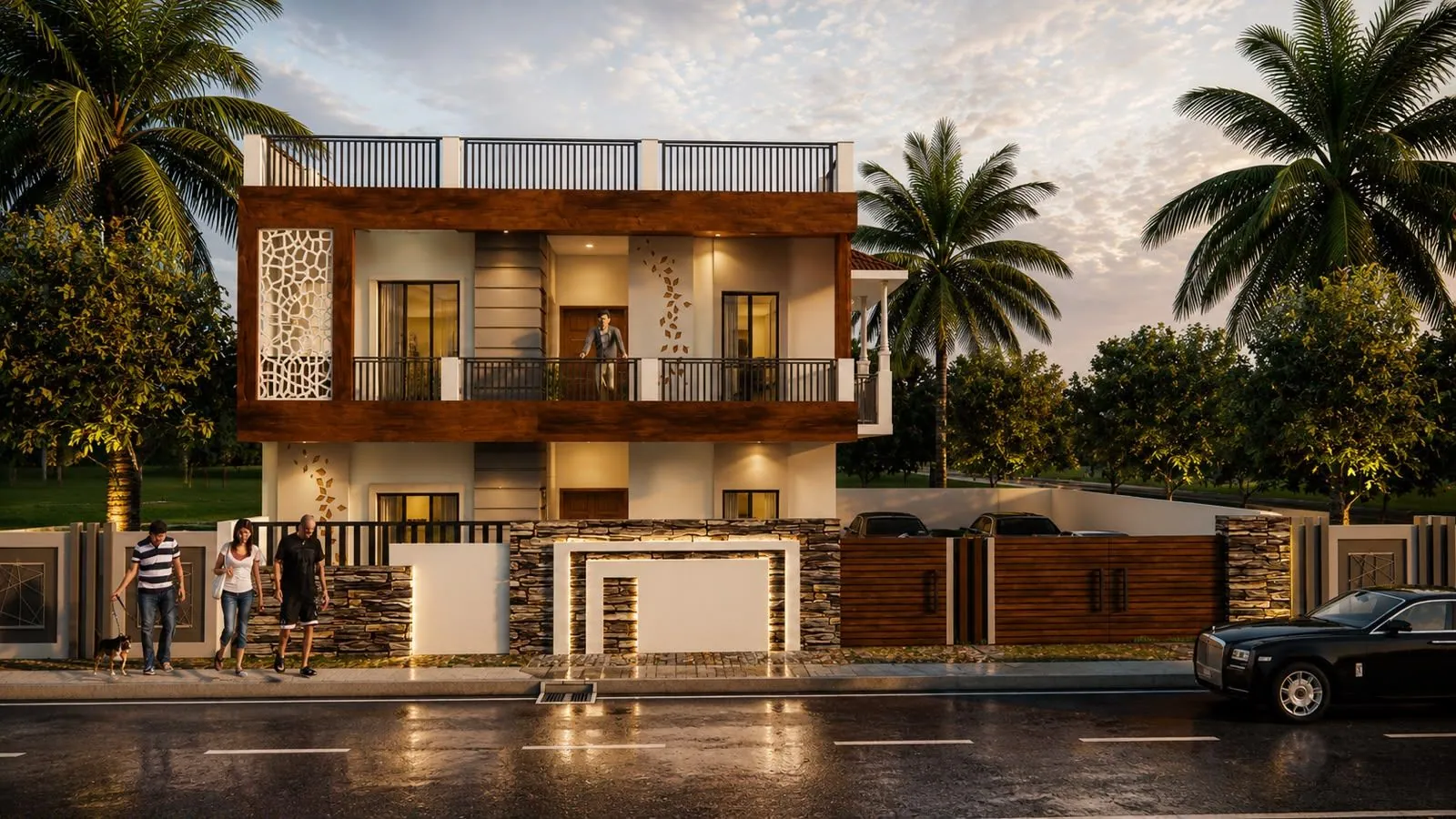
Parapets, a terrace pergola, a solar water heater and a neighbour's taller building also cast shade. A solar water heater competes for the same sunny roof, so decide early how much of the roof each one gets. The picture above is our design for a two-storey home on a north-facing corner plot of about 43 × 49 ft in Gurugram, with an open terrace above the first floor.
Design the roof structure for it
- Tell your structural engineer where the panels will sit. Our structural design already details the water tank; the panel frame belongs on the same drawings.
- For a ballast frame, the guidelines ask for a non-invasive structure loaded with blocks of M25 concrete, so the roof is not drilled. That keeps the waterproofing whole, but the blocks are weight the slab must carry.
- A raised frame keeps the terrace usable underneath; it needs its own anchors or columns, designed with the house.
Run the cables before the plaster
- A spare conduit from the roof to the main distribution board and the meter, with a pull wire inside. Our smart home planning post lists the same spare pipe for solar, cameras and a gate motor.
- A place for the inverter near the distribution board, in shade, with air around it.
- Earthing: the system comes with its own earthing and lightning protection, so leave room in the site plan for the earth pits.
Our electrical design marks conduit routes before the slab is cast, and our plumbing design leaves provision for a solar water heater.
Common questions
Can I apply before my house is complete?
You apply with the consumer account number of a residential connection, so in practice after the connection is in place. Design the roof for solar now, so nothing has to be broken later.
Will a 5 kW system get more subsidy than 3 kW?
No. The CFA stops at 3 kW: ₹78,000 at most, or ₹85,800 in the special-category states.
Can I use imported panels?
Not if you want the subsidy. Modules must be made in India from Indian-made cells.
Naye ghar mein solar kab lagwayein?
Bijli connection milne ke baad apply kar sakte hain, lekin chhat ka plan (mumty, tanki, panel ki jagah aur wire ka pipe) naksha banate waqt hi tay kar lijiye.
Sources
- Ministry of New and Renewable Energy, Operational Guidelines for "Central Financial Assistance to Residential Consumers" under PM-Surya Ghar: Muft Bijli Yojana (7 June 2024): sections 2, 5 and 6, Annexure 2 (site survey) and Annexure 3 (technical specifications); copy on Jharkhand Bijli Vitran Nigam's site, read on 27 October 2026 — https://jbvnl.co.in/SOLAR/Operational%20Guidelines%20to%20PM%20Suryaghar%207%20June%2024.pdf
- National portal for applications — https://pmsuryaghar.gov.in
- Business Today, 28 July 2026, the same amounts still offered — https://www.businesstoday.in/india/story/high-power-bills-burning-pockets-claim-up-to-rs78000-under-pm-surya-ghar-scheme-545483-2026-07-28
Send your plot size and floors on WhatsApp, or use the quote form, and we will plan the roof for solar along with your naksha.
Planning a home on your own plot?
Share your plot size, facing and city. A designer will call you back within one working day with layout options and an honest cost range.