Guide
🏗️ Importance of Mortar in Building Construction
By the Design SQR team · 29 Oct 2026 · 6 min read
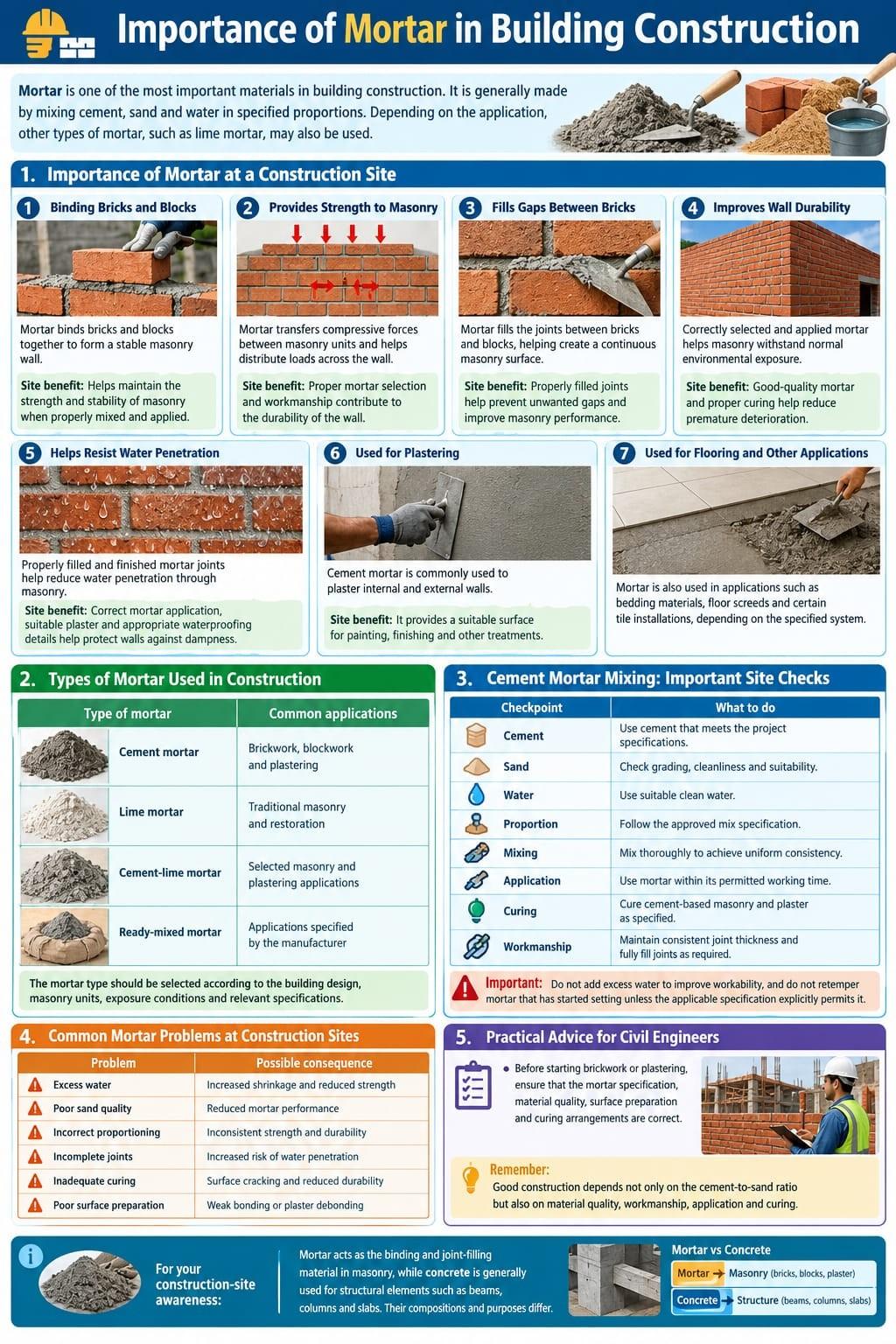
🏗️ Importance of Mortar in Building Construction Mortar is one of the most important materials in building construction. It is generally made by mixing cement, sand, and water in specified proportions. Depending on the application, other types of mortar, such as lime mortar, may also be used.
- Importance of Mortar at a Construction Site
- Binding Bricks and Blocks
Mortar binds bricks and blocks together to form a stable masonry wall. Site benefit: Helps maintain the strength and stability of masonry when properly mixed and applied.
- Provides Strength to Masonry
Mortar transfers compressive forces between masonry units and helps distribute loads across the wall. Site benefit: Proper mortar selection and workmanship contribute to the durability of the wall.
- Fills Gaps Between Bricks
Mortar fills the joints between bricks and blocks, helping create a continuous masonry surface. Site benefit: Properly filled joints help prevent unwanted gaps and improve masonry performance.
- Improves Wall Durability
Correctly selected and applied mortar helps masonry withstand normal environmental exposure. Site benefit: Good-quality mortar and proper curing help reduce premature deterioration.
- Helps Resist Water Penetration
Properly filled and finished mortar joints help reduce water penetration through masonry. Site benefit: Correct mortar application, suitable plaster and appropriate waterproofing details help protect walls against dampness.
- Used for Plastering
Cement mortar is commonly used to plaster internal and external walls. Site benefit: It provides a suitable surface for painting, finishing and other treatments.
- Used for Flooring and Other Applications
Mortar is also used in applications such as bedding materials, floor screeds and certain tile installations, depending on the specified system.
- Types of Mortar Used in Construction
Type of mortar Common applications Cement mortar Brickwork, blockwork and plastering Lime mortar Traditional masonry and restoration Cement-lime mortar Selected masonry and plastering applications Ready-mixed mortar Applications specified by the manufacturer The mortar type should be selected according to the building design, masonry units, exposure conditions and relevant specifications.
- Cement Mortar Mixing: Important Site Checks
Before using mortar, the site engineer should check the following: Checkpoint What to do Cement Use cement that meets the project specifications. Sand Check grading, cleanliness and suitability. Water Use suitable clean water. Proportion Follow the approved mix specification. Mixing Mix thoroughly to achieve uniform consistency. Application Use mortar within its permitted working time. Curing Cure cement-based masonry and plaster as specified. Workmanship Maintain consistent joint thickness and fully fill joints as required. Important: Do not add excess water to improve workability, and do not retemper mortar that has started setting unless the applicable specification explicitly permits it.
- Common Mortar Problems at Construction Sites
Problem Possible consequence Excess water Increased shrinkage and reduced strength Poor sand quality Reduced mortar performance Incorrect proportioning Inconsistent strength and durability Incomplete joints Increased risk of water penetration Inadequate curing Surface cracking and reduced durability Poor surface preparation Weak bonding or plaster debonding
- Practical Advice for Civil Engineers
Before starting brickwork or plastering, ensure that the mortar specification, material quality, surface preparation and curing arrangements are correct. Remember: Good construction depends not only on the cement-to-sand ratio but also on material quality, workmanship, application and curing. For your construction-site awareness: Mortar acts as the binding and joint-filling material in masonry, while concrete is generally used for structural elements such as beams, columns and slabs. Their compositions and purposes differ. Mortar is one of the most important materials in building construction. It is generally made by mixing cement, sand, and water in specified proportions. Depending on the application, other types of mortar, such as lime mortar, may also be used.
- Importance of Mortar at a Construction Site
- Binding Bricks and Blocks
Mortar binds bricks and blocks together to form a stable masonry wall. Site benefit: Helps maintain the strength and stability of masonry when properly mixed and applied.
- Provides Strength to Masonry
Mortar transfers compressive forces between masonry units and helps distribute loads across the wall. Site benefit: Proper mortar selection and workmanship contribute to the durability of the wall.
- Fills Gaps Between Bricks
Mortar fills the joints between bricks and blocks, helping create a continuous masonry surface. Site benefit: Properly filled joints help prevent unwanted gaps and improve masonry performance.
- Improves Wall Durability
Correctly selected and applied mortar helps masonry withstand normal environmental exposure. Site benefit: Good-quality mortar and proper curing help reduce premature deterioration.
- Helps Resist Water Penetration
Properly filled and finished mortar joints help reduce water penetration through masonry. Site benefit: Correct mortar application, suitable plaster and appropriate waterproofing details help protect walls against dampness.
- Used for Plastering
Cement mortar is commonly used to plaster internal and external walls. Site benefit: It provides a suitable surface for painting, finishing and other treatments.
- Used for Flooring and Other Applications
Mortar is also used in applications such as bedding materials, floor screeds and certain tile installations, depending on the specified system.
- Types of Mortar Used in Construction
Type of mortar Common applications Cement mortar Brickwork, blockwork and plastering Lime mortar Traditional masonry and restoration Cement-lime mortar Selected masonry and plastering applications Ready-mixed mortar Applications specified by the manufacturer The mortar type should be selected according to the building design, masonry units, exposure conditions and relevant specifications.
- Cement Mortar Mixing: Important Site Checks
Before using mortar, the site engineer should check the following: Checkpoint What to do Cement Use cement that meets the project specifications. Sand Check grading, cleanliness and suitability. Water Use suitable clean water. Proportion Follow the approved mix specification. Mixing Mix thoroughly to achieve uniform consistency. Application Use mortar within its permitted working time. Curing Cure cement-based masonry and plaster as specified. Workmanship Maintain consistent joint thickness and fully fill joints as required. Important: Do not add excess water to improve workability, and do not retemper mortar that has started setting unless the applicable specification explicitly permits it.
- Common Mortar Problems at Construction Sites
Problem Possible consequence Excess water Increased shrinkage and reduced strength Poor sand quality Reduced mortar performance Incorrect proportioning Inconsistent strength and durability Incomplete joints Increased risk of water penetration Inadequate curing Surface cracking and reduced durability Poor surface preparation Weak bonding or plaster debonding
- Practical Advice for Civil Engineers
Before starting brickwork or plastering, ensure that the mortar specification, material quality, surface preparation and curing arrangements are correct. Remember: Good construction depends not only on the cement-to-sand ratio but also on material quality, workmanship, application and curing. For your construction-site awareness: Mortar acts as the binding and joint-filling material in masonry, while concrete is generally used for structural elements such as beams, columns and slabs. Their compositions and purposes differ.
Planning a home on your own plot?
Share your plot size, facing and city. A designer will call you back within one working day with layout options and an honest cost range.